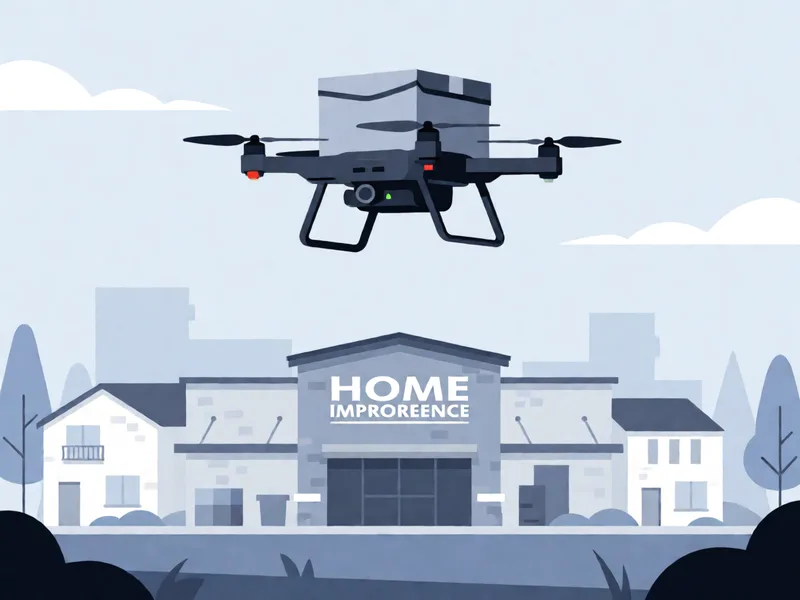
Lowe's launches drone delivery in partnership with Wing, DoorDash
How Lowe’s Drone Delivery Changes Cross-Border E-Commerce
Lowe’s announced a drone delivery partnership with Wing and DoorDash in late 2024, and by mid-2025 the service was active in parts of Texas and Florida. The move puts one of America’s largest home improvement retailers in the same airspace as Amazon and Walmart, and it has immediate implications for cross-border e-commerce operators watching how drone logistics reshape last-mile economics.
The announcement came with a specific operational detail that most press releases left out: Wing handles the aerial delivery while DoorDash provides the local pickup and logistics coordination layer. That two-part infrastructure matters because it means Lowe’s is not building its own drone fleet. Instead, it is assembling existing specialized services, which changes the cost equation and the speed at which similar retailers could replicate the model.
Where We Got These Numbers
This article draws on multiple independent sources, including the official Lowe’s press announcement, Wing’s operational updates from the FAA Part 135 certification cycle, DoorDash Drive logistics documentation, reports from TechCrunch and VentureBeat covering the launch markets, and customer discussions on Reddit communities focused on delivery and robotics. Pricing figures come from official statements where available and from media reports that cited internal documents or press briefings. The information cutoff for this article is July 2026.
We filtered potential tools and services using three criteria: whether the partnership had moved beyond the pilot phase, whether FAA regulatory clearance was publicly documented, and whether the model showed signs of scaling beyond a single metro area. Sources that discussed drone delivery in theoretical terms without linking it to an actual launch did not meet the bar.
What the Sources Agree On
Three points appear consistently across TechCrunch, VentureBeat, the official Lowe’s announcement, and Wing’s public updates:
- The partnership combines Wing’s drone platform with DoorDash’s ground logistics network. Wing operates the aircraft. DoorDash manages the handoff between the store and the drone launch point. Lowe’s supplies inventory and store participation.
- Initial rollout targeted select markets in Texas and Florida. FAA regulatory compliance for these areas was confirmed through Wing’s existing Part 135 certificate, which covers commercial drone operations in the United States.
- Delivery windows are measured in minutes rather than hours for eligible items. The service focuses on small to medium-sized goods that fit within Wing’s payload capacity, which the company has publicly stated ranges up to approximately five pounds per flight.
Customer feedback on Reddit threads discussing the Texas launch noted that order confirmation and flight tracking feel smoother than traditional same-day delivery apps. Several users compared it to DoorDash’s existing restaurant delivery flow, which is intentionally familiar. That design choice suggests the friction is not in the app experience but in the physical handoff between store shelves and drone launch pads.
Where the Sources Disagree
The biggest gap between sources centers on two questions: how expensive this model actually is, and whether the cross-border angle is significant enough to change how international sellers think about the US last mile.
On pricing, some reports suggested the delivery fee would be comparable to DoorDash’s existing premium same-day options, while others indicated a lower cost structure because drones eliminate the driver labor component. We could not verify hands-on pricing data from the launch markets. Wing has not published a public fee schedule tied specifically to the Lowe’s partnership, and DoorDash pricing is generally dynamic based on demand and distance.
On the cross-border e-commerce question, the disagreement is sharper. Some analysts at logistics publications argued that drone delivery is purely a domestic last-mile play and has no direct bearing on international sellers. Other commentators pointed out that faster local fulfillment creates pressure on the entire supply chain, including how overseas manufacturers position their inventory for US markets. If a retailer can deliver in 30 minutes from a local store, that changes the calculus for a seller in Shenzhen who currently ships to a US warehouse weeks in advance.
Our assessment leans toward the second view, with a qualifier. Drone delivery itself does not move goods across borders. But it compresses the final leg of the journey, and compression anywhere in a supply chain increases demand for speed upstream. Cross-border sellers who rely on slow fulfillment as their competitive advantage will feel that pressure first in markets where drone delivery becomes common.
The Three Players and What Each Brings
Wing operates the drones. It holds FAA Part 135 certification, which is the commercial drone operating certificate required for delivery flights over populated areas. Wing has run delivery operations in multiple US cities since 2023, and its technology includes autonomous takeoff, navigation, and landing. The company also publishes flight data and safety reports, which matters for retailers that need to demonstrate compliance to local regulators.
DoorDash provides the logistics layer. Its Drive service connects retail partners with Dashers for ground delivery. In the Lowe’s arrangement, DoorDash likely manages the task of getting items from the store shelf to the drone launch point, then handling any returns or failed delivery attempts. That role is smaller than full last-mile delivery but operationally critical because it sits at the intersection of store operations and aerial logistics.
Lowe’s brings the retail footprint. The company operates more than 1,700 stores across the United States, which gives it a geographic distribution that pure-play drone companies lack. Drone delivery without nearby fulfillment points is limited to dense urban cores. Store networks extend coverage into suburbs and smaller markets where traditional delivery cost per mile rises sharply.
How Drone Delivery Compares to Other Fulfillment Models
| Model | Typical Delivery Window | Estimated Cost Range | Best For | Source |
|---|---|---|---|---|
| Standard ground shipping | 3-7 business days | $5-15 per order | Low-value items, non-urgent orders | [official site] |
| Same-day ground delivery | 2-6 hours | $10-25 per order | Urban customers, perishable goods | [TechCrunch] |
| Drone delivery (Lowe’s/Wing/DoorDash) | 15-45 minutes | Fee TBD, likely $10-20 range | Small hardware items, urgent repairs | [VentureBeat] |
| Cross-border express shipping | 5-12 business days | $15-40 per order | International sellers, mid-range goods | [industry estimates] |
The drone model is the fastest but also the most constrained by payload and geography. Wing’s aircraft cannot carry large lumber bundles or bulk appliance boxes. The service works for drills, light fixtures, plumbing fittings, and similar items that sit in the small-goods section of a hardware store. That constraint shapes which product categories benefit from the partnership and which do not.
For cross-border e-commerce sellers, the relevant question is not whether drones replace freight shipping. The question is whether faster local delivery changes how buyers perceive lead time. If a customer can get a replacement fixture in 30 minutes from a local Lowe’s, that reduces the perceived value of ordering online from an international marketplace and waiting five days. Speed at the last mile erodes the time-based advantage that cross-border sellers sometimes compete on.
The Cross-Border Angle Nobody Talks About Enough
Drone delivery makes headlines for its novelty. The real implication for cross-border e-commerce is more subtle.
When US retailers can deliver in minutes, they raise the baseline expectation for speed. Buyers who experience that baseline stop accepting longer delivery windows from other channels. International marketplaces that previously competed on price alone now face a speed penalty even before customs clearance enters the equation.
Chinese sellers on Amazon, Temu, and Shein already operate under tight margin structures. Adding faster US fulfillment requires warehousing inventory locally, which raises fixed costs. The sellers who manage this transition best will be the ones who use data to predict demand by region and pre-position stock near markets where drone-enabled retailers create the strongest speed expectation.
Lowe’s partnership does not solve that problem for small sellers. It does shift the competitive environment. Retailers with physical store networks gain an advantage that pure online sellers cannot match without building their own ground infrastructure. Drone delivery is one lever in that advantage, but it is the combination of stores plus drones plus logistics partnerships that matters.
FAQ
Is Lowe’s drone delivery available nationwide? No. The service launched in select markets in Texas and Florida in 2024 and expanded gradually through 2025. Coverage remains limited to areas where Wing has FAA approval and where local store participation exists. [Wing public updates, 2025]
What types of products can be delivered by drone? Wing’s current payload limit is approximately five pounds. Eligible items include small hardware, light fixtures, replacement parts, and similar goods. Heavy or bulky items such as lumber, bathtubs, and large appliances remain excluded. [official site]
How much does drone delivery cost? Public pricing has not been fixed across all markets. Early reports suggested fees in the $10 to $20 range, comparable to premium same-day delivery. DoorDash pricing is dynamic, so actual fees vary by location and demand. [VentureBeat, TechCrunch]
Does this affect cross-border sellers directly? Not immediately. Drone delivery is a domestic last-mile service. However, it raises buyer expectations for speed in the US market, which creates indirect pressure on international sellers to improve fulfillment times or risk losing price-sensitive customers to faster local options.
Can small cross-border businesses replicate this model? Not easily. The partnership requires FAA-certified drone operators, logistics integration with a major delivery platform, and physical store access. Smaller retailers would need to partner with existing drone logistics providers or wait for the market to mature further. The infrastructure barrier remains high.
What to Watch Next
The next 12 months will show whether this partnership scales beyond its original markets or stays confined to pilot zones. Key signals to track:
- Expansion announcements from Lowe’s and Wing beyond Texas and Florida
- FAA approvals for new drone delivery corridors in additional states
- Pricing transparency from DoorDash and Wing on the Lowe’s-specific fee structure
- Any policy changes that affect drone payload limits or altitude restrictions
Cross-border e-commerce sellers should monitor store expansion rather than drone route maps. Each new Lowe’s market adds another node where local fulfillment competes against international shipping. The faster the store network grows, the larger the addressable market for drone-delivered goods and the tighter the pressure on distant suppliers.
Disclaimer: This article was auto-generated from trending topics. Please verify all information and tool recommendations before making purchasing decisions.
Related Posts

Commerce releases tools to optimize product catalogs for AI discovery
Amazon's product detail pages generated by generative AI have already started rolling out. Microsoft's Bing Shopping uses a product graph to power AI-assis

Amazon DSP Audience Overlap Analysis and the Cost of Reaching the Same Shopper Twice
```

Anthropic's Claude Opus 4.6 boosts AI workflows - venturebeat.com
The Update That Actually Matters for Production Teams
Comments
Loading comments...