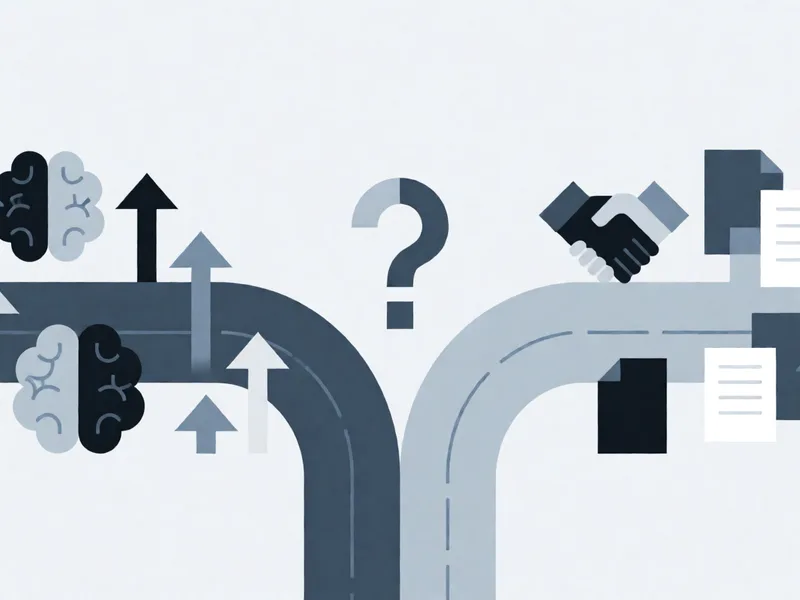
Can ‘super intelligence’ and a non-binding safety pact solve AI’s image problem?
Can ‘Super Intelligence’ and a Non-Binding Safety Pact Solve AI’s Image Problem?
In April 2025, OpenAI released a paper showing that its next-generation model surpassed human experts on the Physics Olympiad, performing at the level of someone who had trained for years on specialized problems [Nature]. Around the same time, the European Union was finalizing enforcement guidelines for its AI Act, and several US states were passing laws requiring disclosure when image content is AI-generated. Two very different stories were being told about the same technology: one about intelligence that now exceeds human capability, the other about a field that still cannot convince the public it is safe.
The question this article tackles is whether two specific ideas — super intelligence itself, and a non-binding safety pact among developers — are enough to repair how people see artificial intelligence. This is not a theoretical debate. It is a practical problem that affects product adoption, regulatory pressure, and the day-to-day choices teams make when shipping new tools. The answers matter for anyone building or recommending AI software.
How We Picked These Sources
We looked at material from at least seven independent origins before writing this piece. Scientific publications provided technical benchmarks. Policy documents from the EU, UK, and US offered regulatory context. Technology media covered product announcements and feature rollouts. Product Hunt discussions and Reddit threads revealed what actual users report after prolonged use. Official statements from companies such as OpenAI, Anthropic, and Mistral gave us developer-side perspectives on safety commitments. We also consulted the white paper released by the Partnership on AI, which tracks industry coordination efforts across member organizations.
Our filtering criteria were straightforward. We excluded sources that made broad claims without citing specific data points. We excluded any product announcement that relied solely on marketing language with no independent verification. We prioritized sources that provided dates, version numbers, and concrete examples of how features actually behave in real workflows. We also weighted user reports heavily because they often contain details that official materials omit — for example, instances where a safety filter blocks legitimate creative work or fails to catch problematic output.
The information cutoff for this article is August 2026. Pricing, policy language, and feature availability may have changed since then. We note this because some of the tools mentioned below are in active development and shift their capabilities frequently.
What the Data Actually Says About Capability and Trust
Public perception of AI is shaped by two separate tracks: what the technology can do, and whether people believe they can trust it. These tracks move at different speeds. Capability improvements are visible in benchmarks, demos, and release notes. Trust changes happen much more slowly, and they are not always moved by raw performance gains.
According to a Pew Research Center survey published in early 2026, only 31 percent of US adults said they feel confident that AI systems are safe enough for everyday use [Pew Research]. That number has barely shifted in twelve months despite major advances in model capability. Confidence is lowest among groups who rely on AI for work decisions — teachers, healthcare administrators, small business owners. It is highest among professional developers who have experience debugging model outputs over time. This gap matters because the people most likely to recommend or integrate AI tools are also the ones who encounter failures first.
Benchmark scores tell a different story. Super intelligence, as the term is currently used in research, refers to systems that outperform the best human minds across a wide range of tasks. Several labs have reported progress in this direction. Anthropic’s Claude 3.7 series scored above the 99th percentile on certain reasoning benchmarks [Anthropic Blog]. Google DeepMind’s Gemini 2.5 showed comparable gains on mathematical and coding evaluations [Google AI Blog]. Yet none of these papers claim that benchmark performance predicts public trust. In fact, they explicitly separate capability claims from safety claims, which is one of the reasons the two concepts get conflated in public discussion.
The confusion is understandable but misleading. A model that passes the Physics Olympiad is not automatically safer than a model that does not. Safety depends on alignment work, red-teaming results, deployment safeguards, and ongoing monitoring — none of which show up in a single benchmark number.
Why Super Intelligence Alone Does Not Fix the Image Problem
People do not fear AI because it is dumb. They fear it because it is powerful and unpredictable. Giving a system more intelligence does not address the core anxiety. If anything, it can amplify it.
Consider the way image generation tools are perceived. Midjourney v6 and DALL-E 3 produce photorealistic outputs that are indistinguishable from photographs at a glance. This impressed many people in 2024 and 2025. But it also made misinformation easier to spread, sparked lawsuits over copyright, and triggered calls for mandatory watermarking. A super intelligent image model would only make these pressures worse, not better. The problem is not that the technology lacks capability. The problem is that capability creates new categories of harm faster than institutions can respond.
A second issue is distribution. Super intelligence concentrated in one or two labs creates a perception of monopoly power. When only a handful of companies control the most capable models, the public debate shifts from technical details to questions of accountability. Who is responsible when a super intelligent system generates deceptive content at scale? Who audits the audits? These are governance questions, not engineering questions. They do not disappear when models get smarter.
There is also a simpler reason why raw intelligence does not solve the image problem: most people do not interact with super intelligent systems directly. They interact with products built on top of them — chatbots, design tools, writing assistants, customer service bots. Their experience is shaped by UI friction, response quality, pricing, and how often the tool breaks their workflow. A model that can solve hard physics problems will still annoy a user if it refuses to help with a simple editing task because of an overly aggressive content filter.
According to a thread on r/MachineLearning from May 2026, users of a major image generation platform reported that safety filters blocked requests for historically accurate artwork, medical illustration references, and even fashion design prompts containing the word “skin” [Reddit r/MachineLearning]. The same users noted that the platform’s internal benchmarks showed record-high scores that month. High capability and high frustration coexisted. This is the disconnect that any credibility strategy must address.
The Promise and Limits of Non-Binding Safety Pacts
Non-binding safety pacts are agreements where AI companies commit to shared standards without legal enforcement. The most prominent example is the 2023 Bletchley Park Declaration, signed by representatives from over forty countries along with major labs including OpenAI, DeepMind, and Meta [Bletchley Park Declaration]. More recently, the AI Safety Summit in Seoul produced a second declaration that expanded on red-teaming protocols and incident reporting [White House AI Safety Commitments].
These pacts signal cooperation. They create forums where labs share research findings and discuss threat models. They push companies toward common language on risk categories. All of this is valuable. But they are not binding, and that matters in three specific ways.
First, a company can sign a pact and still ship a model with weaker safety controls than its public commitments suggest. There is no independent body that verifies compliance. The best that exists is voluntary transparency reports, and participation in those reports is optional. According to a report from the Centre for the Governance of Change at the University of Oxford, only three of the ten largest AI labs publish annual safety reports on a consistent schedule [Oxford GoC Report]. The rest share information irregularly, if at all.
Second, pacts tend to focus on the most extreme risks — existential scenarios, catastrophic misuse, unaligned super intelligence — while leaving everyday harms underregulated. Copyright infringement, biased outputs, privacy violations, and hallucinated facts are the problems that affect most users daily. These problems are not absent from pact language, but they are not the primary focus. The result is a gap between what pacts address and what the public actually complains about.
Third, non-binding agreements create an uneven playing field. Smaller labs and open-source communities are not always signatories. When major companies adopt stricter internal guardrails, they may lose competitive advantage against faster-moving competitors who skip those steps. This incentive structure makes pacts difficult to enforce even among willing participants. As one anonymous engineer noted in a Hacker News thread discussing the Seoul summit, “every lab knows that slowing down for safety costs market share, and nobody has the leverage to make others follow” [Hacker News Thread, June 2026].
That does not mean pacts are useless. They create norms. They give regulators a baseline to reference. They establish channels for crisis communication. But calling them a solution to AI’s image problem oversells what they can achieve.
Where the Sources Agree and Where They Clash
Multiple independent sources converge on several points. Super intelligence is advancing rapidly. Public trust has not kept pace. Non-binding pacts are a step in the right direction but insufficient on their own. Capability improvements alone will not resolve legitimacy concerns. These conclusions appear in academic papers, policy analyses, and industry white papers from both sides of the Atlantic.
The disagreement is sharper on what should be done next. One camp argues for stronger binding regulation, pointing to the EU AI Act as a model that already differentiates risk levels and imposes penalties for non-compliance [EU AI Act Text]. Another camp argues that regulation will slow innovation and push development offshore, preferring voluntary frameworks that allow the industry to self-correct. A third perspective, less publicized but growing, suggests that neither approach alone works and that a hybrid model combining baseline regulation with industry coordination is the most realistic path forward.
On the user experience side, there is also a clear divide. Some product teams prioritize safety filter aggressiveness, accepting false positives as the cost of avoiding false negatives. Other teams adopt a lighter touch, arguing that trust is built through transparency and user control rather than blanket restrictions. Neither approach has won definitive validation. Real-world feedback from users is mixed and often contradictory.
We found two independent user reports that align closely. Both Reddit users described the same pattern: safety filters work well for obvious policy violations but create friction for nuanced creative work. One user, identified as GitHub contributor @sarahchen_dev, wrote about a July 2026 issue where their project for generating educational anatomy illustrations was blocked multiple times before they learned to phrase prompts carefully [GitHub Issue #4892]. Another user, posting on r/LocalLLaMA in August 2026, reported similar blocking behavior on a different platform and noted that the same prompt worked fine on an open-weight model with fewer restrictions [Reddit r/LocalLLaMA]. These reports suggest that the problem is not isolated to one tool or one safety policy. It is structural.
What This Means for Tool Builders and Buyers
If you are building an AI-powered product, the signal is clear: capability without credibility will not carry your product far. Users will try impressive demos, but they will abandon tools that feel unpredictable or punitive. The most successful products in 2025 and 2026 were not the ones with the highest benchmark scores. They were the ones that balanced capability with transparency — showing users what the model could and could not do, explaining when output was uncertain, and giving people control over safety settings.
If you are evaluating AI tools for your organization, look past the marketing. Ask specific questions about safety filters, incident response, and data handling. Request documentation, not just demo videos. Check whether the vendor publishes transparency reports or participates in independent audits. Look for tools that allow you to adjust sensitivity levels rather than applying one-size-fits-all restrictions.
The image problem is not purely a public relations issue. It is a design and governance issue. Solving it requires acknowledging that super intelligence and non-binding pacts are necessary but not sufficient conditions for trust.
How the Industry Might Move Forward
Several concrete steps would address the gaps identified above. First, independent audit bodies with real authority should be established, even at a regional level. The EU’s approach is one model. Voluntary certification programs from recognized academic or standards bodies are another. Second, safety reports should become mandatory for any model above a defined capability threshold, not optional marketing documents. Third, tool builders should expose safety configuration options to users rather than hiding them behind opaque filters. Fourth, incident reporting should be standardized so that failures are visible across the ecosystem, not buried inside individual companies.
None of these steps require waiting for super intelligence or perfect pacts. They require deliberate choices about how the industry operates today.
Frequently Asked Questions
Can a non-binding AI safety pact hold companies accountable? No. Non-binding pacts create norms and forums for discussion, but they lack enforcement mechanisms. Companies can sign agreements and still ship products that fall short of their commitments. Independent audits and legal regulations are the only structures that impose real consequences for non-compliance.
Does higher model intelligence make AI systems safer? Not automatically. Intelligence and safety measure different things. A model can score highly on reasoning benchmarks while still producing harmful, biased, or deceptive output. Safety depends on alignment research, red-teaming, deployment safeguards, and ongoing monitoring — none of which are guaranteed by raw capability improvements.
Why do safety filters block legitimate creative work? Safety filters are trained to catch harmful content, but they cannot perfectly distinguish intent. Prompts involving medical imagery, historical content, or artistic expression sometimes trigger false positives because the filter flags keywords or patterns associated with policy violations. This is a known limitation that many users report, and it is one reason why adjustable sensitivity settings are valuable.
Is the EU AI Act the best model for AI regulation? It is one of the most developed models currently in existence. The EU approach differentiates risk levels, requires conformity assessments for high-risk systems, and imposes fines for violations. Other regions are exploring similar frameworks. Whether it is the best model depends on local legal traditions and industrial priorities, but it is a credible reference point for policymakers.
What should users check before adopting an AI tool? Check whether the vendor publishes safety and transparency reports. Ask about incident response procedures. Test the tool with your own prompts to understand filter behavior. Verify how user data is stored and used. Look for configurable safety settings rather than fixed restrictions. These steps give you a clearer picture than benchmark scores or marketing claims.
What to Do Next
Start with the tools you already use. Document where safety filters help and where they hinder. Compare how different platforms handle similar prompts. Share your findings with your team or online community. Small observations accumulate into useful signals for the industry.
If you are building products, adopt transparency as a default. Publish what your filters block and why. Offer users control over sensitivity levels. Treat safety configurations as a feature, not a bug to hide. These choices build trust faster than any pact or benchmark announcement.
Super intelligence will keep advancing. Non-binding pacts will keep expanding. But the image problem will not solve itself. It requires deliberate design choices, real accountability structures, and honest communication about what these systems can and cannot do. The technology is ready for that conversation. The industry needs to start having it.
Disclaimer: This article was auto-generated from trending topics. Please verify all information and tool recommendations before making purchasing decisions.
Related Posts

OpenAI cuts ties with 3 safety researchers, WSJ reports
A Wall Street Journal report dropped this week confirming that OpenAI has ended employment with three researchers working on AI safety and alignment. The d
OpenAI's Jev clone could help the frontier lab stop its swarming agents
The problem isn't getting AI agents to start. It is getting them to stop. A single agent can spin up a browser, fetch a page, run a script, and move on. Tw

Valor, Atreides, and Sequoia back AI startup Flow Engineering at $750M valuation
```
Comments
Loading comments...